


As new semiconductor fabs come online and process tools are installed and commissioned, engineers face a deceptively fundamental question: Which type of pressure measurement does each chamber or system actually need?
It sounds basic. But choosing the wrong pressure reference can lead to apparent pressure drift, recipe inconsistencies, unstable control, and lengthy troubleshooting during equipment commissioning.
Absolute Pressure: The Choice for Vacuum Processes
An absolute pressure sensor measures pressure relative to a sealed vacuum reference (0 Torr / 0 Pa). The measurement is therefore independent of changes in local atmospheric pressure.
This is particularly important for semiconductor processes such as etch, CVD, PVD, and ion implantation, where the chamber operates at sub-atmospheric pressure.
For example, at a process pressure of 100 mTorr, atmospheric pressure at sea level is approximately 760 Torr — about 7,600 times higher. With an absolute pressure reference, changes in atmospheric pressure do not directly shift the measurement reference.
Typical applications:
Etch chambers
CVD / ALD chambers
PVD / sputtering systems
Ion implantation
Other low-pressure process chambers
For vacuum processes, absolute pressure is generally the preferred reference when stable and repeatable process pressure measurement is required.
Gauge Pressure: When Atmosphere Is the Baseline
A gauge pressure sensor measures pressure relative to local atmospheric pressure. Positive gauge pressure indicates pressure above atmosphere, while negative gauge pressure indicates pressure below atmosphere.
Gauge pressure is widely used for positive-pressure facility and utility systems, where relative pressure is more important than the exact absolute pressure.
Typical applications:
Facility cooling water supply and return
Process cooling fluid circulation
Compressed clean dry air (CDA)
N₂ supply lines
Gas cabinet supply pressures
For these applications, the key concern is typically whether the system is operating within the expected pressure range relative to ambient conditions. Gauge sensors are therefore often a practical and cost-effective choice.
Differential Pressure: Measuring the Relationship Between Two Points
A differential pressure sensor measures the pressure difference between two ports:
ΔP = P₁ − P₂
Neither port needs to be referenced directly to vacuum or atmosphere. The focus is the pressure difference between two locations.
Common semiconductor applications include:
Cleanroom pressure cascades — monitoring pressure gradients between controlled areas to help manage contamination migration.
UPW filter monitoring — measuring pressure drop across a filter to identify loading or clogging.
Exhaust / abatement systems — monitoring pressure drop across scrubbers and abatement equipment to detect abnormal conditions or blockage.
Differential pressure is about understanding the relationship between two points, rather than the absolute pressure at either point.
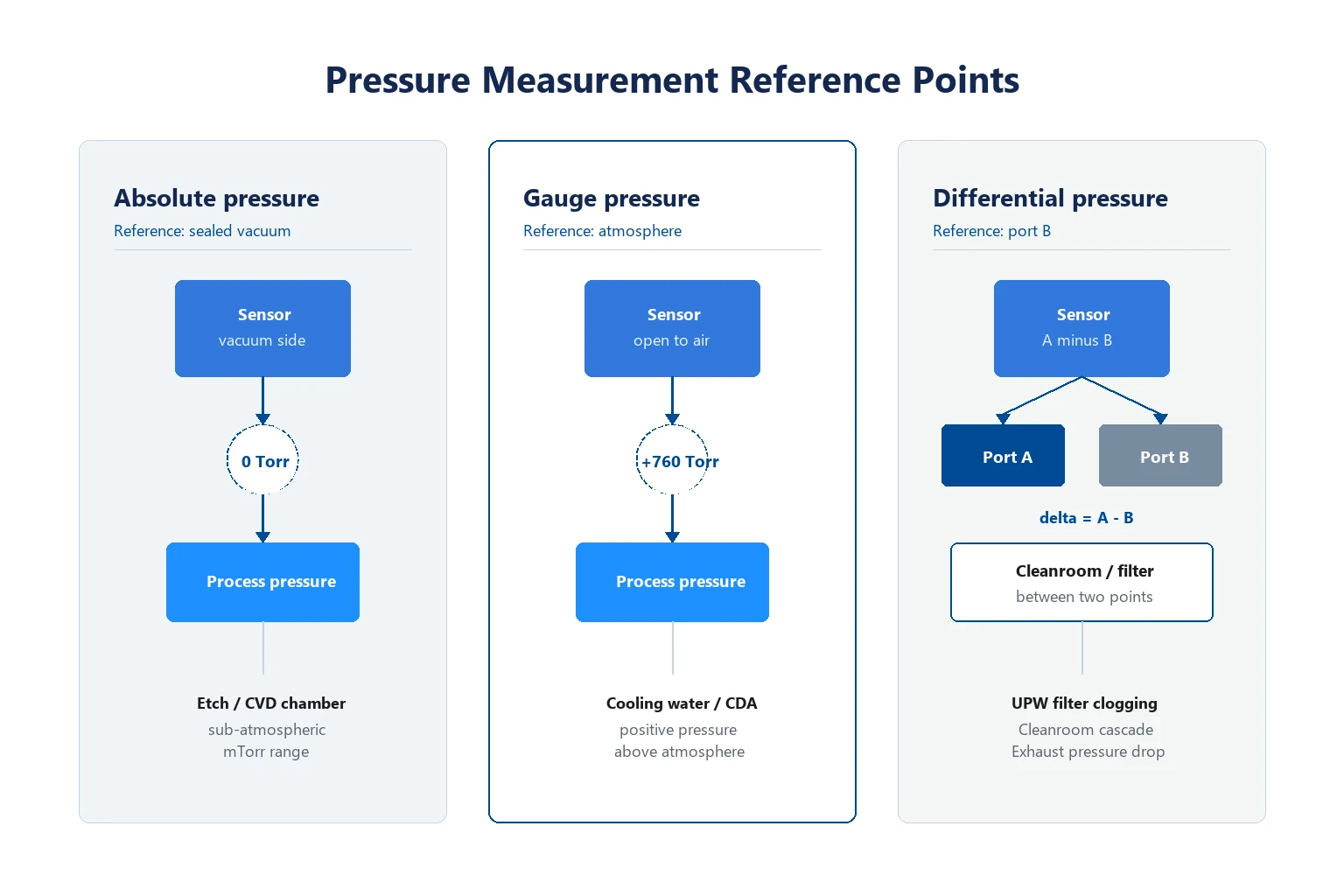
Pressure measurement reference points: absolute, gauge, and differential pressure.
What Happens When You Choose the Wrong Reference?
One important example is using a gauge-referenced sensor for a low-pressure vacuum application.
Atmospheric pressure changes with weather, altitude, and building conditions. These variations may be negligible in a high-pressure utility system, but they become significant when the measured process pressure is only a few hundred mTorr.
For example, if a 200 mTorr process were measured using an atmospheric-referenced sensor, a 15 Torr change in atmospheric pressure would correspond to a theoretical ±7.5% change relative to the process pressure.
The actual impact depends on the sensor architecture and measurement system, but the underlying issue remains:
When the process pressure is extremely low, the pressure reference matters.
An inappropriate pressure reference can contribute to apparent pressure drift, unstable control, and unnecessary troubleshooting during tool commissioning.
Pressure Selection Guide for Semiconductor Applications
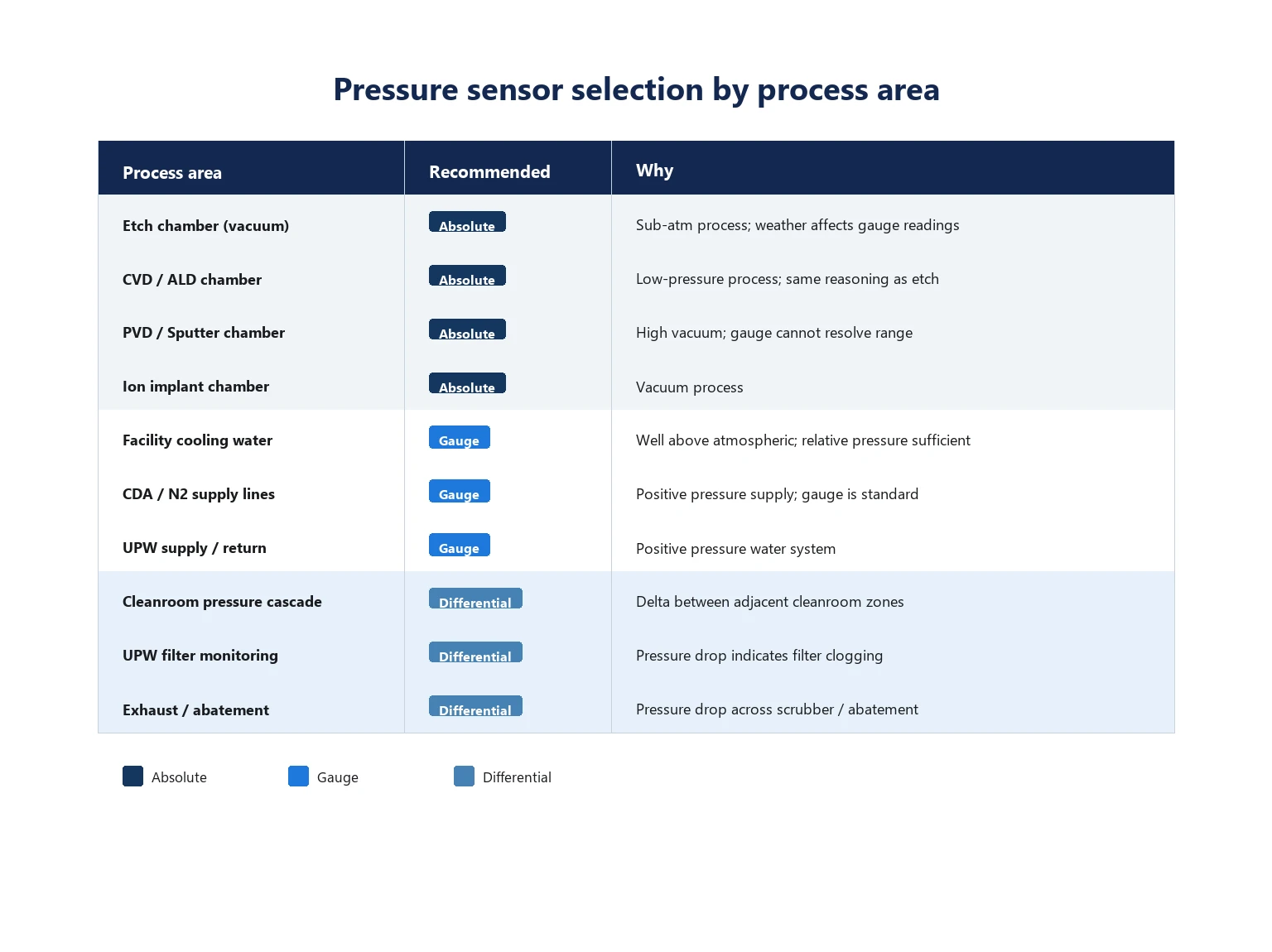
Pressure sensor selection by process area in semiconductor applications.
| Process Area | Recommended Type | Main Reason |
|---|---|---|
| Etch chamber | Absolute | Low-pressure vacuum process |
| CVD / ALD chamber | Absolute | Stable low-pressure measurement |
| PVD / Sputtering | Absolute | Vacuum process |
| Ion implantation | Absolute | Vacuum process |
| Diffusion / RTP | Absolute / Gauge | Depends on process pressure range and control requirements |
| Facility cooling water | Gauge | Positive-pressure utility system |
| CDA / N₂ supply | Gauge | Positive-pressure supply |
| UPW supply / return | Gauge | Positive-pressure water system |
| Cleanroom pressure cascade | Differential | Pressure difference between zones |
| UPW filter monitoring | Differential | Pressure drop indicates filter loading |
| Exhaust / abatement | Differential | Pressure drop across scrubber or abatement equipment |
Key Takeaway
Pressure reference is more than a procurement specification — it can directly affect measurement stability and process control.
For low-pressure semiconductor processes, absolute pressure is generally the preferred reference. For positive-pressure facility and utility systems, gauge pressure is often the most practical solution. When the relationship between two points matters — such as filter loading, cleanroom pressure gradients, or exhaust pressure drop — differential pressure is the appropriate measurement approach.
At BICCNS, we develop pressure measurement solutions for semiconductor equipment and UHP applications, including process pressure, gas delivery, wet process systems, and facility utilities.
Not sure which pressure type fits your application? Send us your process pressure range, medium, and application. Our engineering team can help evaluate the appropriate pressure reference, measurement range, and wetted material.
Follow BICCNS for more technical insights on pressure, flow, and temperature measurement in semiconductor manufacturing.