


In industrial applications, it’s not uncommon to see ultrasonic flowmeters showing fluctuating readings—or even failing to measure altogether. In many cases, the issue is not with the instrument itself, but with its Signal-to-Noise Ratio (SNR).
1. What is Signal-to-Noise Ratio (SNR)?
Simply put, SNR is the ratio between the useful signal and background noise.
Think of it like having a conversation in a noisy restaurant:
· Signal: your friend’s voice
· Noise: clattering dishes and surrounding conversations
When this ratio is in an ideal state, the ultrasonic signal remains clear and stable, allowing the flowmeter to provide reliable and accurate measurement data.
2. What Causes “Noise”?
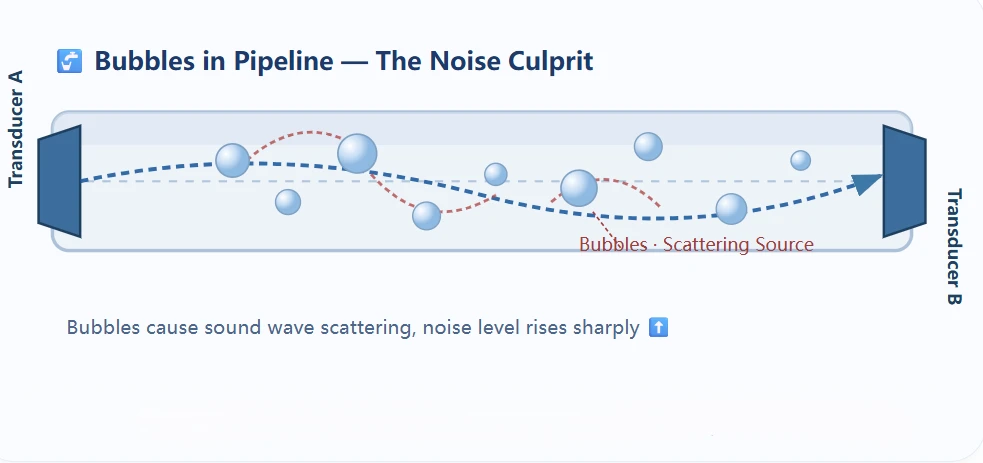
In ultrasonic flow measurement, one of the most common sources of noise is air bubbles.
· Scattering & Reflection: Excessive bubbles cause strong scattering and reflection of ultrasonic waves, significantly increasing noise levels.
· Data Distortion: When noise becomes too high, the transit-time difference may exceed the processing limits, resulting in distorted or invalid data.
3. How to Improve “Hearing”?
To enhance SNR, improvements can be made from two key aspects:
• Improve Process Conditions
Maintain clean pipelines, control gas-liquid content, and minimize impurities to reduce unwanted reflections at the source.
• Optimize Technology
· Hardware Upgrade: Use high-performance sensors to capture even weak signals.
· Software Enhancement: Implement advanced digital signal processing algorithms—just like premium noise-cancelling headphones—to extract accurate flow signals from noisy environments.
Conclusion
SNR is one of the most critical indicators of ultrasonic flowmeter performance.
Understanding it gives you a powerful “stethoscope” to diagnose measurement issues. When selecting or maintaining a flowmeter, prioritizing signal clarity is far more important than simply pursuing “good-looking” data.